

To thoroughly implement the spirit of the Council of Heads of the SCO member state and steadily advance the implementation of the SCO doctoral student innovation training plan, as well as to improve the transnational collaborative doctoral training system, the second working meeting of the Council of the China–SCO Doctoral Student Training Innovation Centerwas held on June 17 at Belarusian National Technical University. The meeting was coordinated and organized by Harbin Institute of Technology, the chair university, representatives from member universities in six countries: China, Russia, Belarus, Kazakhstan, Kyrgyzstan, and Uzbekistan, gathered online offline to discuss key issues including the Center’s development, credit recognition, and operating mechanisms.
Representatives from SCO member state universities, including Peking University, Tsinghua University, Xi’an Jiaotong University, Beijing Foreign Studies University, Harbin Institute of Technology, Saint Petersburg State University, RUDN University, Al-Farabi Kazakh National University, L.N. Gumilyov Eurasian National University, Belarusian National Technical University, Yanka Kupala State University of Grodno, RazzakovKyrgyz State Technical University, and New Uzbekistan University, attended the meeting and exchanged views.
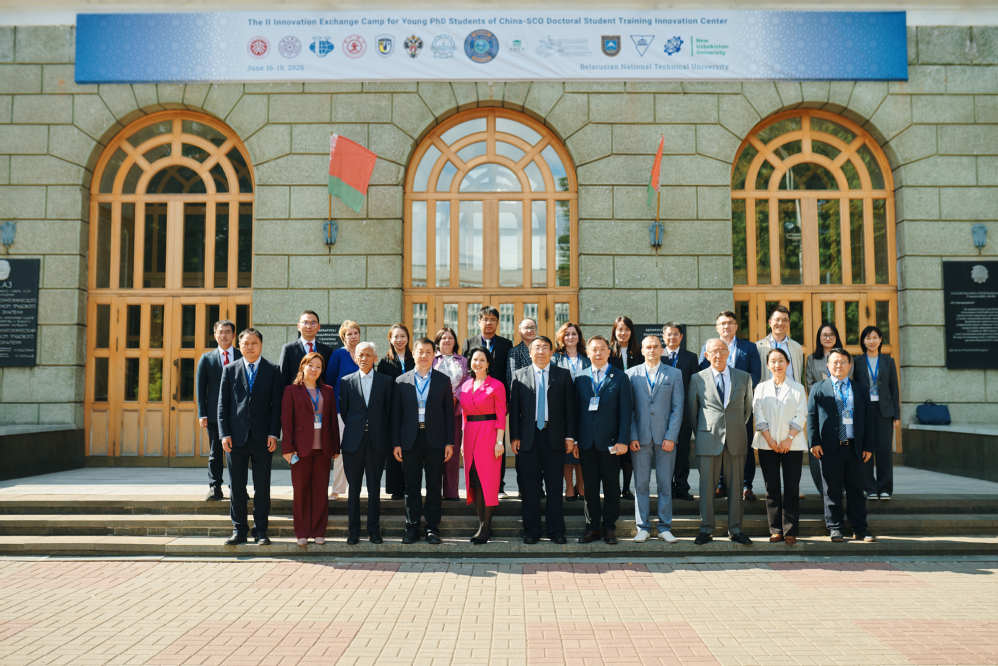
The Second Working Meeting of the Council
Liu Ting, Vice President of Harbin Institute of Technology, attended and chaired the meeting. Li Jun, Deputy Dean of the Graduate School and Director of the Graduate Cultivation Office, delivered a special report on the Center’s construction progress and medium-term and long-term development plan on behalf of the chair university. The report summarized the phased achievements made by the Center since itsestablishment and operation in cross-border doctoral student recruitment, the establishment of joint supervisor teams, joint scientific research in frontier disciplines, and organization of international academic exchange camps. Focusing on key cooperation areas such as energy, artificial intelligence, and the digital economy, it clearly identified key tasks for the next stage, including cross-border joint training, joint course collaboration, research platforms sharing, and exchange activities for Chinese and foreign doctoral students. It also proposed a standardized, regularized, and sustainable development path for international high-level talent cultivation, comprehensively responding to the concerns of all member universities.
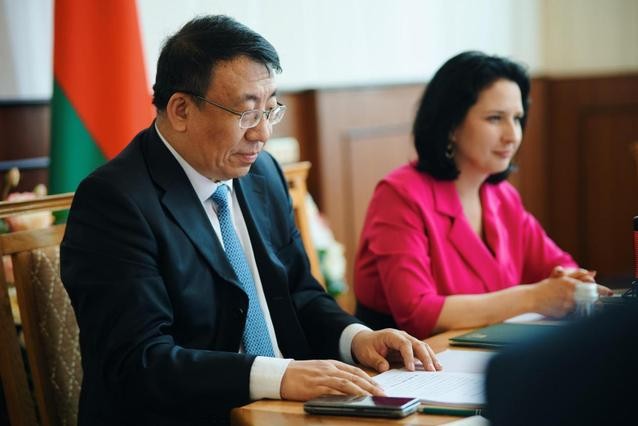
Liu Ting delivered the speech
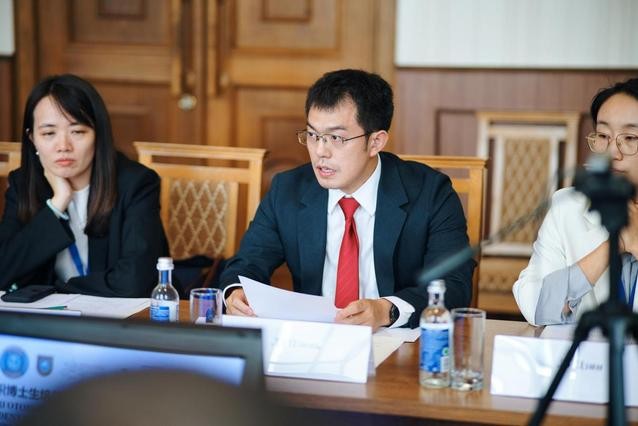
Li Jun reported on the Center’s work
At the meeting, all participating representatives jointly reviewed and signed the China–SCO Doctoral Student Training Innovation Center Graduate Course Credit Recognition Agreement. The agreement standardizes the fundamental principles for doctoral-level course recognition, credit transfer, and mutual recognition of learning outcomes among universities in the six countries, providing institutional guarantees for cross-university course selection, joint training, and short-term visiting studies for doctoral students in SCO member states.
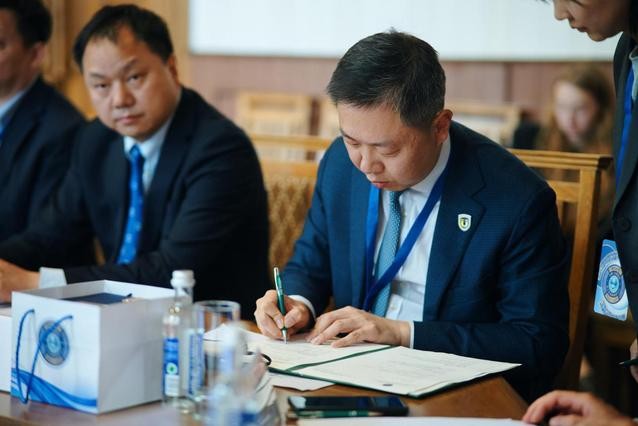
Participating representatives signed the credit recognition agreement
The participating representatives conducted in-depth discussions on the operation mechanism of the Center, and fully exchanged opinions on core issues such as the rotating chairsystem of the council and the establishment of the academic committee and the expert committee. All parties proposed optimization suggestions based on the actual situation of their own respective universities in graduate education management, reached a unified consensus on revisions, clarified the working norms of the Center, and built a collaborative and efficient sustainable operating system.
Kseniya Yakushenko, Vice Rector of Belarusian National Technical University, and representatives of foreign universities expressed their full support for the Center’s construction, commitment to implementing the framework agreement on credit recognition, and deepening joint training and scientific research cooperation. The representatives of Chinese universities promised to play a leading role and promote cooperation in joint course collaboration, mutual visits of supervisors, and academic exchanges.
Liu Ting concluded in his summary that the second working meeting of the council completed the signing of the credit recognition agreement and finalized the Center’s standardized operating mechanisms, marking the Center’s transition from framework construction to a new stage of institutionalized and standardized operation. Supported by the credit recognition framework agreement and unified operating mechanisms, the Center will improve its full-chain collaborative training system, jointly cultivate international top-notch talents, and contribute to the construction of the SCO community of shared future by educational cooperation.
The meeting consolidated the institutional foundation, provided guarantees for the the regular and high-quality operation o the Center, and promoted the continuous deepening of the integrated cooperation in education, science and technology, and talent within the SCO.